The watch that almost brought four centuries of mechanical watchmaking to an end arrived in an 18-carat gold case. Released by Seiko on Christmas Day 1969, the Quartz Astron cost roughly as much as an average car in Japan and kept time to approximately five seconds a month, around 100 times more accurately than a typical mechanical watch of its era. Beneath its elegant dial, a vibrating crystal appeared to have made the mainspring, gear train and escapement obsolete. It had not. Quartz went on to transform the industry, bringing extraordinary precision to millions of wrists, yet mechanical watchmaking survived and ultimately became more desirable. Today, an inexpensive quartz watch may outperform a costly mechanical calibre, while maisons such as Patek Philippe and Cartier use quartz in watches of unquestionable luxury. Accuracy, it turned out, was only part of what people wanted.
14 August 2026
Mechanical vs. Quartz Watches: What’s the Difference?
BY ONARO

The real difference between quartz and mechanical watches is therefore not simply how they keep time, but how they ask us to live with it. Quartz offers discreet autonomy. A manually wound movement creates a ritual between the hand and the crown. An automatic calibre draws energy from the gestures of its wearer. Each measures the same hours, yet each creates an entirely different relationship with the person carrying it. Turn the crown of a mechanical watch and something begins to tighten beneath your fingertips. You cannot see the mainspring coiling inside its barrel, but you can feel its resistance grow. That stored energy will pass through a train of wheels before an escapement releases it in tiny, measured impulses. Hold the watch close and you can hear the exchange: a spring attempting to relax while the calibre carefully restrains it. The same principle animated the earliest portable watches of the sixteenth century, when time first escaped the clock tower and began travelling with its owner. Those watches were imperfect, delicate and deeply personal. They had to be wound with separate keys and carried close to the body, their ticking a private sound.

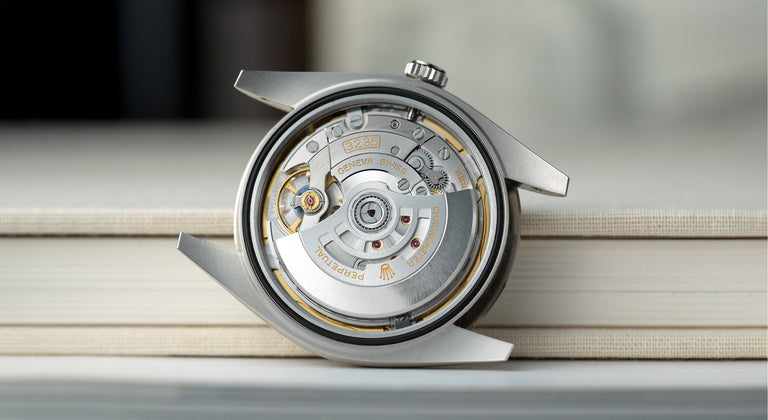
A manually wound watch preserves something of that intimacy. It asks the owner to return to it, to place a hand on the crown and restore the energy that has gradually been spent. For example, Patek Philippe’s Calatrava 8-Day Ref. 5328G-001 makes the ritual unusually unhurried. Its calibre stores enough power to run for approximately a week, so winding becomes less a daily chore than a considered moment of attention. There is pleasure in that dependence. The watch cannot pretend to be autonomous; its continued motion begins with a human gesture. An automatic watch creates a subtler exchange. Beneath the case back, a weighted rotor turns as the wrist moves, translating a walk through the city, a lifted suitcase or a hand raised in conversation into energy for the mainspring. For example, Patek Philippe’s Calatrava Pilot Travel Time Ref. 5524G-010 feels especially suited to this arrangement. Designed to accompany movement between cities and time zones, it is itself sustained by movement. Leave it untouched for long enough, however, and it will fall silent. “Automatic” has never meant perpetual. It simply allows the watch to depend on its owner less obviously.

This is why manual and automatic should not be viewed as different levels of quality. Both are mechanical, both rely on the same essential architecture and neither is inherently more accurate. A hand-wound calibre can be slimmer and leaves its bridges and wheels unobstructed beneath a sapphire-crystal case back. An automatic offers greater convenience, and its rotor can become a canvas for finishing and decoration. The choice is one of temperament: the deliberate ritual of winding versus the quiet companionship of a movement sustained by the body.

Quartz asks for neither ritual. A battery sends electricity to a crystal vibrating 32,768 times each second, creating a rhythm far more stable than that of a conventional mechanical balance. The seconds hand may advance with a visible tick, but behind it is an extraordinarily precise process. A quartz watch can rest in a drawer for weeks and still be ready when its owner returns. It does not need to be kept alive by the wrist or restored through the crown. There is an understated luxury in that reliability, the freedom to choose the watch only when the occasion calls for it. That freedom explains why quartz is not confined to inexpensive watches. Cartier uses it in versions of the Tank, Panthère and Santos-Dumont, where a compact movement helps preserve the elegance and proportion of the case. Patek Philippe’s 32 mm Ladies’ Nautilus contains an 80-part quartz calibre with eight jewels, combining years of autonomy with the finishing, materials and design language expected of the manufacture. In these watches, quartz is not an apology or a shortcut. It is the movement best suited to the object the maison wanted to create.

Luxury, after all, does not reside in one component. It may be found in the architecture of a calibre, but also in the curve of a case, the texture of a dial, the articulation of a bracelet or the precision of a diamond setting. A mechanical movement does not automatically make a watch exceptional, just as a battery does not prevent one from being so. Quartz and mechanical are technologies; the quality of the watch depends on what is made from them. Nor can a movement determine how much a watch will eventually mean. A quartz watch worn through a marriage, carried across continents or inherited from a parent may hold more emotional weight than a grand complication kept permanently inside a safe. Sentiment is created by time spent together. The movement merely shapes the terms of that companionship.
Choosing between quartz, manual and automatic is therefore less about selecting the “best” technology than deciding how present you want the watch to be in your life. Quartz offers precision and the freedom to forget. A manually wound watch creates a private ritual between owner and calibre. An automatic sits between them, mechanically alive yet sustained almost unconsciously by the wearer. One technology perfected the convenient measurement of time; the other transformed measuring it into an experience. The finer choice is the one whose rhythm feels closest to your own.

 Item added to bag