30 September 2026

September 2026 Watch Releases: 9 New Watches That Caught Our Eye

BY EMILE KUKLYTE

A watch can look entirely new and still begin with an idea that is more than seventy years old. It can appear wonderfully simple while concealing years of development inside its movement, or seem familiar until one small change transforms the way it feels on the wrist. After the quieter summer months, September brought another wave of releases and, with it, a collection of stories that deserve more than a quick photograph and a list of specifications.

There were many more releases than we could explore in one article, but these nine caught our attention. Nine watches for September, the ninth month of the year. Some look deep into the archives, while others introduce movements, materials and ways of displaying time that did not previously exist. What connects them is not one particular style, but the feeling that each becomes more interesting when you understand what sits behind it. These are the details that made us stop, look again and want to learn more.

Front and caseback views of the Laurent Ferrier Classic Moon Dusk in yellow gold, featuring a taupe-to-chocolate dial, annual calendar, moonphase display and brown leather strap.

Laurent Ferrier Classic Moon Dusk

Laurent Ferrier has always understood that a complicated watch does not need to look complicated. Before establishing his own manufacture, Ferrier spent nearly four decades at Patek Philippe, and that experience can still be felt in the proportions, finishing and quiet confidence of his work. His watches rarely demand attention from across a room. They reveal themselves gradually, which is part of their appeal. The Classic Moon Dusk places an annual calendar and moon phase inside an 18 carat yellow gold case, yet the first thing you notice is its colour. The dial moves through taupe, chocolate and warm golden tones, creating an appearance that feels richer and softer than the colder silver and blue combinations often used for calendar watches. The moon phase at six o’clock is made from gold sheen obsidian, a naturally variable material whose surface changes subtly under different light.

An annual calendar understands that some months contain 30 days and others contain 31. A conventional date display may need correcting several times a year, while the Classic Moon requires only one adjustment, when February becomes March. It is not as mechanically complex as a perpetual calendar, but it offers much of the same everyday convenience with a simpler construction. What makes the watch interesting is how little effort it appears to make. There is a date, day, month and moon phase on the dial, but no sense that the information has been squeezed into the available space. This is the first Classic Moon presented in a yellow gold Classic case, and the material suits it. The result feels traditional without looking like a direct recreation of something from the past.

Blue and raspberry-pink versions of the M.A.D.Editions M.A.D.3 Vincent Calabrese, featuring wandering-hour displays, polished steel cases and cream leather straps.

M.A.D.3 Vincent Calabrese

M.A.D. Editions grew from the same world as MB&F, a manufacture known for treating a watch movement as a mechanical sculpture rather than something that must remain hidden beneath a conventional dial. M.A.D. brings some of that imagination into a more approachable setting, but the M.A.D.3 is especially interesting because of the people involved. Vincent Calabrese has spent more than fifty years questioning how a mechanical watch should work and how it should display time. He was also among the founders of the AHCI in 1985, an organisation created to give independent watchmakers a platform outside the large Swiss groups. Eric Giroud, who designed the 40mm steel case, has helped shape numerous MB&F creations and understands how to make an unconventional idea feel like a complete object.

The M.A.D.3 reinterprets Calabrese’s Baladin concept. A traditional jumping hour remains still before changing instantly at the top of the hour. Calabrese disliked the abruptness of that transition, so he developed a display in which the hour travels gradually across the dial while the minutes continue to move. It creates a more visible sense of time passing and, once understood, becomes surprisingly intuitive. Inside is a La Joux Perret G111 automatic movement combined with a module developed by MB&F, offering 55 hours of power reserve. As the rotor turns, openings within it gradually reveal a sentence chosen by Calabrese about the difference between pleasing others and being proud of oneself. Pink was reserved for MB&F’s existing community, while blue was offered through a public raffle. The M.A.D.3 is playful and relatively accessible, but the ideas behind it come from one of independent watchmaking’s most original figures.

Tudor Northflag GMT in stainless steel with an integrated bracelet, black dial, date window, 24-hour scale and yellow GMT and seconds hands.

Tudor Northflag

When the original North Flag arrived in 2015, it marked a turning point for Tudor. Its angular case, integrated bracelet and yellow accents looked unlike the historically inspired models that were becoming central to the brand, but the larger development was inside. It was the first Tudor to contain the manufacture Calibre MT5621, signalling that the company was ready to rely less heavily on movements supplied by others. The North Flag was important, but it never became as widely recognised as the Black Bay. Its design was more modern, its integrated bracelet gave it a particular character, and its power reserve display made the dial different from almost everything else Tudor produced. It was eventually discontinued, leaving behind a watch that many people only began to appreciate once it had disappeared.

The new Northflag returns in a 40mm steel case, but Tudor has changed its purpose. The power reserve indicator has gone, replaced by a GMT function powered by Calibre MT5652 U. A fourth hand shows a second time zone against the 24 hour scale around the outer edge of the dial. Unlike many GMT watches, there is no rotating bezel, which preserves the compact, architectural appearance of the original design. The movement provides 65 hours of power reserve and carries both COSC chronometer and METAS Master Chronometer certification. COSC tests the movement for accuracy, while METAS examines the completed watch and also assesses its water resistance, power reserve and resistance to magnetic fields. At 12.7mm thick, the case is slimmer than the original, and the integrated bracelet now includes Tudor’s T fit clasp for adjustment without tools. The changes make it easier to wear, but Tudor has resisted turning it into another variation of the Black Bay.

Two A. Lange & Söhne 1815 Up/Down watches with blue dials, power-reserve and small-seconds displays, shown in pink-gold and white-gold cases with alligator-leather straps.

16:15

A. Lange & Söhne 1815 Up/Down

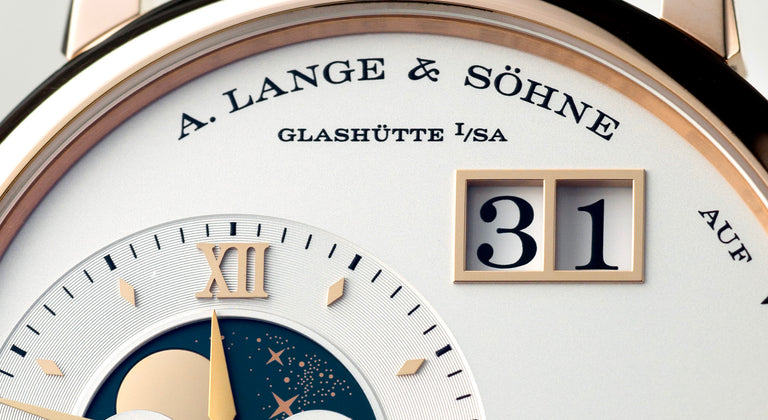
The words Auf and Ab, meaning up and down, have appeared on A. Lange & Söhne watches since the era of precision pocket watches. Together, they form a power reserve indicator that shows whether the movement is fully wound or approaching the point at which it will stop. On the 1815 Up/Down, the indicator sits at eight o’clock and is balanced by the small seconds at four. The arrangement is symmetrical without feeling rigid. Arabic numerals and a railway minute track recall the company’s historic pocket watches, but the two new editions introduce deep blue dials with contrasting argenté coloured subdials. One is housed in white gold and the other in pink gold.

The important figure is 37.5mm. The earliest modern 1815 Up/Down measured 35.9mm, while the later version grew to 39mm. Rather than choosing either extreme, Lange has settled between them. A difference of 1.5mm may sound insignificant, but a simple dress watch leaves nowhere for poor proportions to hide. Its manually wound L051.2 movement provides 72 hours of power reserve, meaning the watch can be put down on Friday evening and still be running on Monday. Through the sapphire back, the movement carries the details expected from Lange, including an untreated German silver three quarter plate, gold chatons held by blued screws and a balance cock engraved by hand. Each metal is limited to 300 pieces. The interest lies not in reinventing the dress watch, but in how carefully Lange has reconsidered its dimensions without losing its character.

Bulgari Octo Finissimo Dual Time x Vianney Halter in titanium, featuring separate local and second-time-zone displays, a retrograde date, day-and-night indicator and integrated bracelet.

Bulgari Octo Finissimo Dual Time x Vianney Halter

Many watch collaborations amount to a new dial colour and a second name on the box. The Octo Finissimo Dual Time x Vianney Halter goes much further. Bulgari’s Octo Finissimo is known for its extreme thinness, broad geometric case and clean architectural surfaces, while Vianney Halter’s watches belong to a different world. His 1998 Antiqua used separate circular displays arranged across an unconventional case, creating something that resembled an instrument from an imagined past. It became one of the defining designs of early independent watchmaking.

The collaboration places Halter’s four dial arrangement inside the Octo Finissimo. The displays indicate local time, a second time zone, the date and whether it is day or night in the additional time zone. Separating each function gives the information room to breathe, while the overlapping circles add depth to a watch normally defined by its flat surfaces. Fitting that architecture into an Octo Finissimo required a new ultra thin manufacture movement, the BVF 200, so the collaboration has altered far more than the appearance of an existing model. The titanium edition feels closer to the cool, industrial character of Bulgari, while the rose gold version on leather moves nearer to the warmth and mechanical eccentricity of Halter’s own work. It remains unmistakably an Octo Finissimo, but it could not have existed without Vianney Halter.

Three Rolex Perpetual Padellone annual-calendar watches in Everose gold and platinum, featuring day and month windows, pointer dates and moonphase displays on leather straps and a Settamo bracelet.

16:19

Rolex Perpetual Padellone

Long before the Submariner, GMT Master or Daytona came to define Rolex, the company produced a small number of complicated calendar watches. Among the rarest was reference 8171, introduced around the beginning of the 1950s. Its broad 38mm case earned it the Italian nickname Padellone, loosely meaning large frying pan, since the case was genuinely substantial for its period. Together with the water resistant reference 6062, it represents a short chapter in which Rolex combined a complete calendar with a moon phase. The modern watch measures 39mm and is available in Everose gold with a white dial or platinum with an ice blue dial. The day and month appear beneath 12 o’clock, a central blue hand indicates the date, and the moon phase sits at six. The full and new moons are made from meteorite, with the darker moon receiving a blue PVD treatment.

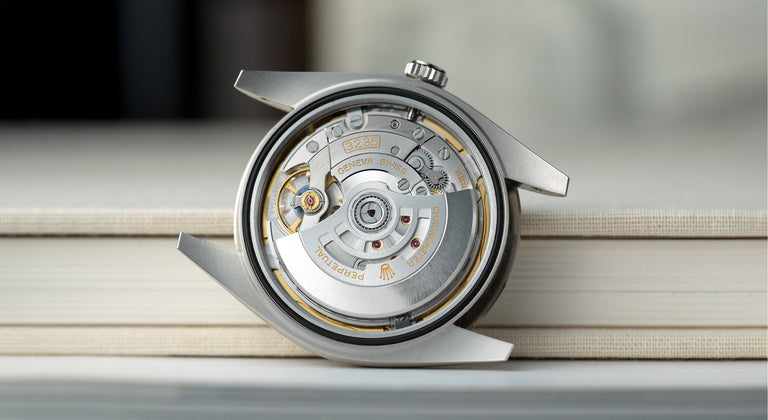
The greatest difference is mechanical. The original reference 8171 used a complete calendar that required regular correction, while Calibre 7190 powers an instantaneous annual calendar that recognises months containing 30 and 31 days. It needs adjusting only once a year, when February becomes March, and the day, date and month change together at midnight. The movement develops the architecture introduced with the Land Dweller and uses Rolex’s Dynapulse escapement, designed to reduce friction by delivering energy directly to the balance. The Everose model can be worn on leather or Rolex’s seven link Settimo bracelet, while the platinum version is paired with an alligator strap. Rolex rarely revisits its more complicated history so directly, which gives the Padellone a character quite different from an annual update to one of its established collections.

Audemars Piguet Royal Oak Selfwinding Chronograph “Serena Williams” in white ceramic, featuring a pink mother-of-pearl dial, three chronograph counters and an integrated bracelet.

Audemars Piguet Royal Oak Selfwinding Chronograph Serena Williams

Serena Williams has worked with Audemars Piguet for more than a decade, but this Royal Oak is more than a familiar watch carrying an ambassador’s name. Williams was involved in shaping its colours, materials and overall character, while Audemars Piguet used the release to introduce an important movement to the 38mm Royal Oak Chronograph. The case, bezel, crown and bracelet are made from white ceramic. Ceramic is highly resistant to scratches, but significantly more difficult to finish than steel. That matters on a Royal Oak because the design depends on the contrast between brushed surfaces and narrow polished bevels. The pink mother of pearl dial changes as it catches the light, while white gold hands, rhodium coloured chronograph indications and a pink date complete the display. A second pink rubber strap is also supplied.

Inside is Calibre 6401, a newly developed integrated automatic chronograph. Unlike a movement created by placing a timing module on top of an existing calibre, an integrated chronograph is designed from the beginning as one complete mechanism. It uses a column wheel to control the starting, stopping and resetting functions, together with a patented vertical clutch intended to provide smoother engagement and greater reliability. The hour and minute counters sit at three and nine o’clock, with the date between four and five. A 22 carat pink gold rotor can be seen through the sapphire back, carrying the colour of the dial into the movement. Limited to 500 pieces, the watch introduces something technically important beneath a design that will probably receive most of the immediate attention.

Panerai Luminor PAM01714 with a blue dial and black DLC-coated case beside the stainless-steel PAM01711 with a green dial, both on matching canvas straps.

Panerai Luminor 42mm

Two millimetres may not sound transformative, but proportions work differently on a Panerai. Moving from the familiar 44mm Luminor case to 42mm keeps the broad dial, crown guard and unmistakable presence of the original while making it easier to imagine on a wider range of wrists. It is still substantial at 13.8mm thick, and that matters. Reduce a Luminor too far and it risks losing the physical character that made the design recognisable in the first place. The new model also looks back to 1993, before Panerai became part of the Vendôme Group, when the company began offering its military inspired watches to the public.

Three versions have been introduced. Two combine brushed and polished steel cases with matte black or green dials, while the third uses a matte blue dial and a steel case treated with black DLC. All feature beige Super LumiNova and canvas straps chosen to complement their dials. Unlike the layered sandwich construction associated with many modern Panerai watches, these use printed luminous markings, creating a connection with some of the early civilian references. Inside is the automatic P.980 movement, which provides 72 hours of power reserve. Its smaller architecture helped make the 42mm case possible, while a solid caseback supports 500 metres of water resistance. Panerai has not made a small watch. It has simply reconsidered how much size is necessary to preserve the identity of a Luminor.

Vacheron Constantin Overseas Perpetual Calendar Ultra-Thin in white gold with an azure-blue dial, shown on its integrated bracelet and white rubber strap.

Vacheron Constantin Overseas Perpetual Calendar Ultra Thin

The Overseas celebrates its thirtieth anniversary in 2026. Introduced in 1996, the collection developed Vacheron Constantin’s interpretation of a luxury sports watch, following earlier models including the 222 from 1977. The anniversary Overseas Perpetual Calendar Ultra Thin returns to the appearance of that first generation through a softer azure blue dial, while retaining the construction and interchangeable bracelet system of the modern collection. Its white gold case measures 41.5mm across and only 8.1mm thick. For context, that is slimmer than many simple automatic watches, yet the Vacheron displays the day, date, month, moon phase and leap year.

A perpetual calendar accounts for months of different lengths and also understands the four year leap year cycle. If the watch remains running, its calendar will not require manual correction until 2100, when the Gregorian calendar omits a leap year. Making all of this fit into such a thin case is Calibre 1120 QP/1, an automatic movement measuring only 4.05mm thick. It provides 40 hours of power reserve and carries the Hallmark of Geneva. The azure dial has a sunburst and lacquered finish, accompanied by pale blue printing and luminous applied markers. The watch is supplied on a white gold bracelet, along with white and denim blue rubber straps that can be exchanged without tools. Limited to 200 numbered pieces, it brings together the relaxed practicality of the Overseas with one of traditional watchmaking’s most demanding complications.

Line-up of new watches from Audemars Piguet, A. Lange & Söhne, Bulgari, Panerai, Laurent Ferrier, M.A.D.Editions, Vacheron Constantin and Rolex on a dark background.

A closer look at September

September brought many more new watches than we could explore here, but these nine were the ones that caught our attention and made us want to look a little closer. Some drew us in through their history, while others introduced an unusual way of displaying time, a newly developed movement or a familiar design reconsidered through different proportions. They may have little in common at first glance, but each rewards the time taken to understand what lies behind it.

That is often where the real pleasure of watchmaking begins. A watch becomes more interesting when we understand why it was created, where its design came from and what had to happen before it could exist. We hope this closer look has revealed a few details that might otherwise have been missed, and perhaps introduced you to a watch, a maker or a small corner of watchmaking history that you will now see differently.

Your Bag
Enquiry
Provide information about your watch

I would prefer to be contacted by

Where did you hear about us?

By submitting this form, you are subject to our Terms & Conditions.